Types of dreams: Understanding origins and scientific purposes
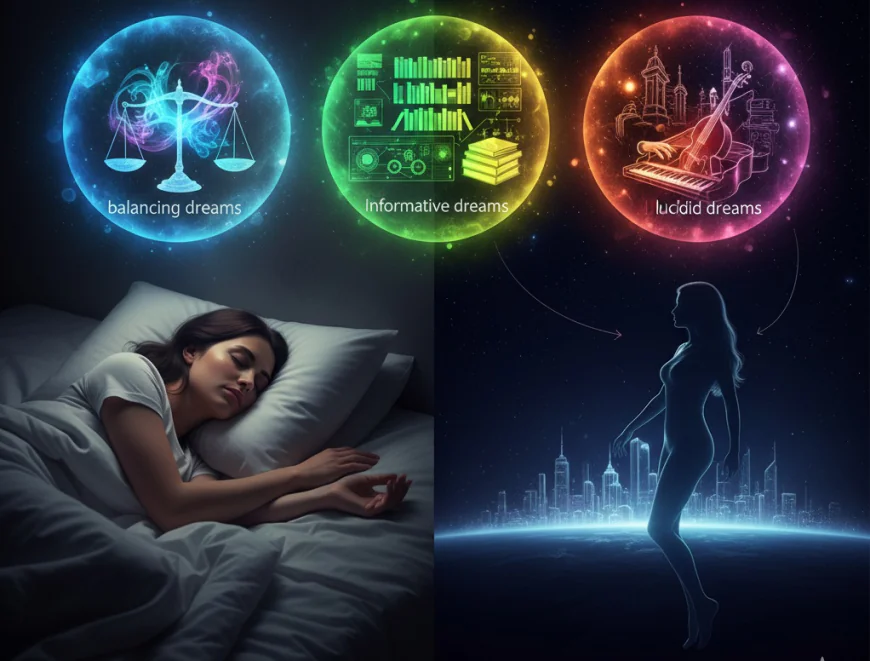
Scientific research and neo-spiritual views categorize dreams into balancing, informative, creative, and prophetic types based on their psychological origins.
 editor


DREAMS WISDOM / NEW YORK, USA
Modern laboratory research and neo-spiritual perspectives suggest that dreams are not merely random images but serve specific biological and psychological purposes. Experts categorize dreams into several types, ranging from "ordinary" psychological reflections to "messenger dreams" that provide warnings or information about the future.
While ordinary dreams are often rooted in daily physical and psychological experiences, purposeful dreams act as tools for guidance, emotional stabilization, and even scientific inspiration.
Mental equilibrium and the learning process
Balancing dreams aim to stabilize our psychological state. Dr. Perlis from the University of Arizona argues that dreams occurring during REM sleep have therapeutic qualities. Furthermore, Nobel laureate Francis Crick and Graeme Mitchison suggest that a primary purpose of dreaming is "reverse learning"—the elimination of unnecessary or harmful neural connections in the brain. Psychiatrists Dr. Greenberg and Dr. Pearlman add that during REM sleep, information recorded during the day is processed in a virtual environment, strengthening existing neural pathways and creating new ones.


Creativity and prophetic messenger dreams
"Creative dreams" are those that provide the inspiration for a work of art, an invention, or the birth of a new concept. In contrast, "prophetic dreams" involve information regarding future events, often cloaked in symbols. According to Jung, psychic energy plays a significant role in these experiences. In experiments conducted by Dr. David Ryback in Atlanta, it was determined that 8.8% of participants experienced dreams that eventually came true. Historical examples include the dreams of Prophet Joseph and the Pharaoh as described in sacred texts.
Lucid dreaming: Conscious awareness in sleep
Lucid dreaming is a scientifically verified state where an individual becomes aware that they are dreaming while the dream is still in progress. In this state, the experience is perceived as entirely real, and some individuals can even consciously direct the dream's content. While lucid dreams can occur spontaneously, experts note that individuals can be trained to enter this state voluntarily, marking one of the highest levels of mental activity during sleep.
Classification based on origins
From Aristotle to modern parapsychologists, dreams have also been classified by their origins. Research identifies three main categories: psychophysiological dreams originating from the subconscious, physicochemical dreams influenced by the environment or chemicals, and psychic or paranormal dreams involving the use of extrasensory abilities during sleep.