


The secret power of Subhanallah: A dhikr that carries the throne
Discover the profound meaning and hidden virtues of the Subhanallah dhikr, a spiritual practice believed to erase sins and empower the angels.


By Bilge Türk | My Dream Meaning
NEW YORK, USA — The profound Islamic remembrance "Subhanallah" holds a deeply rooted history, originally revealed to empower angels carrying the divine throne and later shared by all prophets.
This spiritual practice, which requires only minutes a day, is traditionally believed to cleanse a person of sins as vast as the ocean's foam. Understanding the true linguistic meaning and proper application of this dhikr is essential for believers seeking inner peace, divine protection, and immense spiritual rewards in the afterlife.
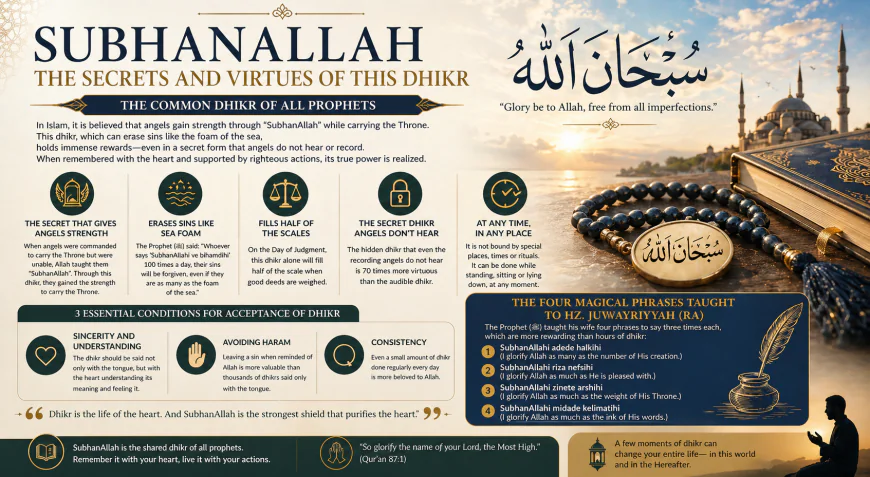
The secret that empowered the angels
According to Islamic traditions, the origin of this dhikr predates human existence. When Allah commanded the angels to carry the divine throne, they lacked the strength to do so. It was only after Allah taught them the word "Subhanallah" that they found the power to bear the immense weight.


Over time, this remembrance evolved into a shared prayer among all prophets. Prophet Adam was inspired to say "Alhamdulillah," Prophet Noah added "La ilaha illallah," and Prophet Muhammad completed the sequence with the Takbir ("Allahu Akbar"), forming a universal declaration of faith that unites the messages of all messengers. The Prophet noted that these praises circle the divine throne with a buzzing sound like bees, constantly reminding the Creator of the believer reciting them.
The deep linguistic meaning of Subhanallah
The word "Subhan" is derived from the Arabic root "sebh," which translates to swimming swiftly in water. Just as a swimmer rapidly moves forward, saying "Subhanallah" signifies swiftly distancing Allah from any perceived flaws, weaknesses, or imperfections.
Mentioned nearly 300 times in the Quran, this phrase is a profound acknowledgment of divine perfection. It is a declaration that the Creator is completely free from fatigue, need, error, or human limitations, reinforcing the core monotheistic belief of Islam.
Forgiving sins like the foam of the sea
Prophet Muhammad emphasized the immense weight of daily repetitions of this phrase. Islamic teachings state that anyone who recites "Subhanallahi wa bihamdihi" 100 times a day will have their minor sins forgiven, even if they are as abundant as the foam of the sea.


Furthermore, when poor companions complained they could not afford to give charity or free slaves like the wealthy, the Prophet offered a solution to level the spiritual playing field. He advised them to recite "Subhanallah," "Alhamdulillah," and "Allahu Akbar" 33 times each after every obligatory prayer, assuring them that this practice would elevate their status above those who merely possessed material wealth.
The four powerful phrases taught to Juwayriyya
The quality and depth of remembrance often outweigh mere quantity. A famous historical account details the Prophet leaving his wife, Juwayriyya bint al-Harith, performing dhikr after the morning prayer. Upon returning hours later, he found her still engaged in worship.
He informed her that he had recited four simple phrases three times, which weighed heavier on the divine scale than all her hours of continuous remembrance. These transformative phrases were:
"Subhanallahi adada khalqihi (by the number of His creation), Subhanallahi rida nafsihi (to His pleasure), Subhanallahi zinata 'arshihi (by the weight of His Throne), and Subhanallahi midada kalimatihi (by the ink of His words)."
The unmatched virtue of hidden dhikr
While communal or vocal remembrance holds great value, the "hidden dhikr" performed silently within the heart carries unparalleled merit. It is reported in
On the Day of Judgment, after the angels present their recorded deeds, Allah will reward the believer from a special, secret ledger of hidden dhikrs that only the Divine knew about, protecting the worshipper from the spiritual danger of showing off (riya).
Interpretations of Islamic scholars: Hasan al-Basri
For the dhikr to be truly accepted, historical Islamic scholars emphasize the absolute necessity of sincerity and avoiding forbidden acts. The prominent scholar Hasan al-Basri stated:
"The reward for remembering Allah without anyone noticing is immense. However, remembering Allah when faced with something forbidden, and consequently avoiding that haram, is even superior."
According to classical scholars, the true essence of Subhanallah is not just verbal repetition. If a believer recites the phrase thousands of times but fails to abstain from major sins, the spiritual value of the dhikr is significantly diminished.
Three conditions for accepted remembrance
Religious experts and contemporary scholars highlight three vital conditions for an effective dhikr practice:
-
Sincerity: The words must resonate in the heart, deeply contemplating Allah's flawlessness rather than just moving the tongue.
-
Abstaining from Haram: A verbal dhikr must be supported by a holistic lifestyle where the body physically abstains from sin out of reverence for the Creator.
-
Consistency: The Prophet taught that the most beloved deeds to Allah are those done consistently. Reciting a smaller amount of dhikr every single day is vastly preferred over a massive amount done only once.
What's Your Reaction?
 Like
0
Like
0
 Dislike
0
Dislike
0
 Love
0
Love
0
 Funny
0
Funny
0
 Wow
0
Wow
0
 Sad
0
Sad
0
 Angry
0
Angry
0

Editorial Desk |DreamWisdom.com is a comprehensive knowledge and editorial platform focused on dreams, dream interpretation, and dream science. The platform explores religious, psychological, cultural, and scientific perspectives, bringing together classical dream traditions with modern analytical approaches.


















Comments (0)